Table of Contents
- Introduction
- Core Dimensions and Form Factor
- Side-by-Side Specification Comparison
- Capacity and Energy Density
- Discharge Performance and Thermal Management
- Application Differences
- Where the 18650 Still Wins
- Where the 21700 Takes Over
- Cost and Supply Chain Trade-offs
- The 2026 Outlook
- FAQ
- Is a 21700 battery simply better than a 18650?
- Can I replace 18650 cells with 21700 cells in an existing device?
- What is the highest capacity 18650 cell available at Keeppower?
- What is the highest capacity 21700 model?
- Do 21700 cells last longer than 18650 cells?
- Which format should I spec for a custom battery pack?
- Do protected 18650 and 21700 cells cost more than bare cells?
Introduction

The 18650 is the veteran of cylindrical lithium-ion cells: compact, widely available and proven in everything from flashlights to early electric vehicles. The 21700 is its larger successor, built to pack more energy into a single can. For OEM and product engineers, the choice between 18650 vs 21700 cells is rarely about which one is universally better – it is about matching cell size to your device’s energy target, volume envelope, discharge needs and cost structure. This comparison lays out the specifications, trade-offs and 2026 trends, using Keeppower product lines as concrete reference points.
Core Dimensions and Form Factor
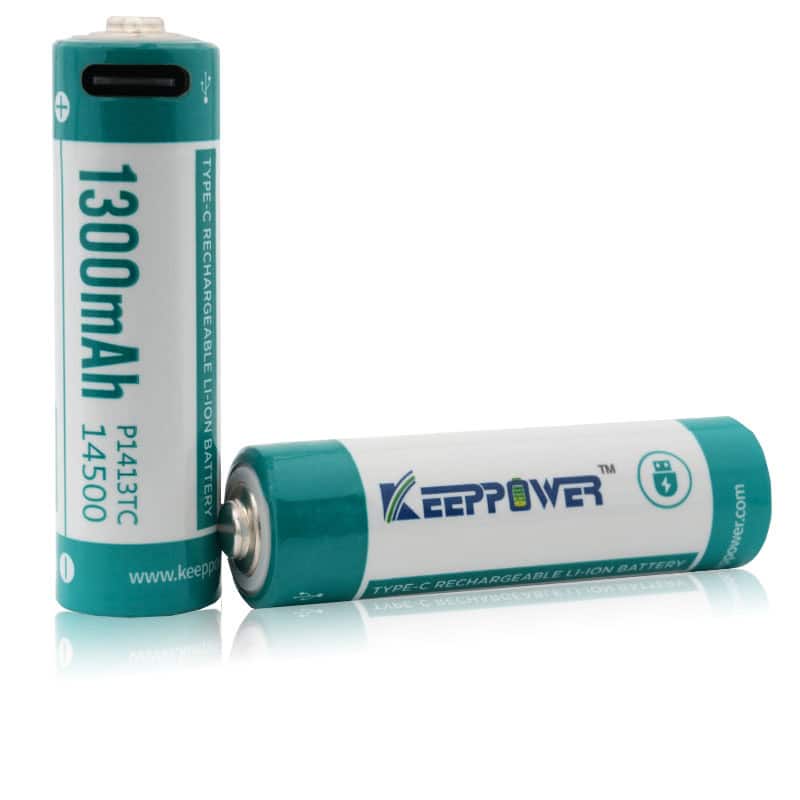
The naming convention tells most of the story. A 18650 cell is 18 mm in diameter and about 65 mm tall; a 21700 cell is 21 mm in diameter and about 70 mm tall. The 21700 is therefore both wider and longer – roughly 17 percent larger in diameter and about 8 percent taller. Protected versions add a small PCB at the end: the Keeppower P1835J protected 18650 measures about 18.6 x 69.1 mm, and protected 21700 cells similarly run slightly longer than the bare cell. That mechanical difference is why a 21700 cannot simply drop into a device designed for 18650 holders.
Side-by-Side Specification Comparison
The table below summarizes the two formats using Keeppower’s representative products as anchors.
| Parameter | 18650 | 21700 |
|---|---|---|
| Dimensions (diameter x height) | About 18 x 65 mm | About 21 x 70 mm |
| Representative protected model | P1835J: 3500mAh (min 3350mAh) | P2165C: 6500mAh |
| High-capacity cell ceiling | Up to about 4000mAh (18650-4000LD) | Up to about 6500mAh class (P2165C) |
| Nominal voltage | 3.6 / 3.7V | 3.6 / 3.7V |
| Strengths | Mature supply chain, low cost, compact size | More energy per cell, fewer cells for target pack energy |
| Trade-offs | Energy ceiling; limited Wh per cell | Bigger volume, higher cell cost, new mechanical design |
| Typical applications | Flashlights, sensors, small packs, portable electronics | Power tools, e-mobility, drone packs, energy storage |
Capacity and Energy Density
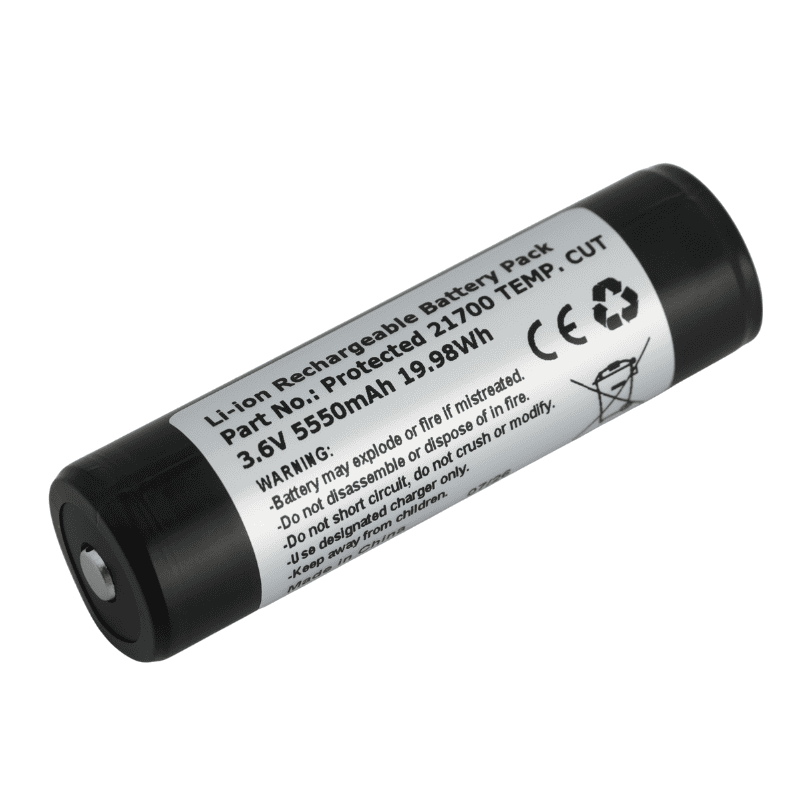
Capacity is where the two formats diverge most clearly. Top-tier 18650 cells reach about 3500 to 4000mAh: the Keeppower P1835J protected 18650 delivers a typical 3500mAh (minimum 3350mAh), and the Keeppower 18650-4000LD cell reaches 4000mAh per Keeppower product pages. The 21700 platform moves the ceiling higher still: Keeppower’s P2165C 21700 protected battery is rated at 6500mAh.
The practical consequence is pack design. To reach a target energy, a 21700 pack needs fewer cells in parallel than an equivalent 18650 pack, which shortens nickel buswork, lowers interconnect resistance and simplifies the BMS. Browse the ranges directly: 18650 high-capacity cells versus 21700 high-capacity cells. The supporting physics – why a higher capacity cell usually tolerates a lower discharge rate – is explained in battery capacity vs discharge rate.
In practical energy terms, a 6500mAh 21700 at 3.7V stores roughly twice the watt-hours of a 3500mAh 18650 in a can that is only about 30 percent larger in volume. That ratio is the core reason device makers migrate larger products to the 21700: more usable runtime per cell without a proportional increase in bulk. The trade-off appears at the pack level, where fewer parallel cells mean each individual cell must carry a larger share of the load, so the current rating per cell deserves the same attention as capacity.
Discharge Performance and Thermal Management
Capacity is not discharge. High-power applications need cells rated for high C-rate output, and Keeppower grades its high-discharge cells into tiers: up to 3C, 3C to 8C, and 8C and above. On the 18650 side, the P1830RC protected 18650 is built for up to 15A discharge while retaining 3000mAh – proof that compact format and high power can coexist.
Thermally, the larger 21700 can sink more heat per watt-hour thanks to its greater mass, but it also concentrates heat in a smaller number of cells, so pack designers rely on spacers, nickel width and PCM current thresholds to keep temperatures in check. The protected single cells in both formats share the same safety envelope: 4.2V charge maximum, 2.5V discharge cut-off, overcurrent and short-circuit protection, and over 500 charge-discharge cycles on representative models.
It is also worth separating two ideas buyers often conflate: the cell format and the cell grade. A 21700 optimized for maximum capacity is not automatically a high-discharge cell, and a well-spec’d 18650 built for power can deliver more amps than a high-capacity 21700. When peak current is the design driver, select the discharge grade first – Keeppower lists its high-discharge cells in tiers up to 8C and beyond – and only then choose the can size that meets the energy target.
Application Differences
Where the 18650 Still Wins
The 18650 remains the sensible choice when space is tight, volumes are large and cost matters most: flashlights, small portable electronics, sensors and cost-sensitive packs. Its mature supply chain also means stable pricing and many compatible holders, spacers and chargers, including the popular L4 intelligent charger that handles both 18650 and 21700 cells in the same bay. Keeppower builds custom 18650 battery packs for exactly these compact use cases.
Where the 21700 Takes Over
The 21700 dominates where energy per cell and high current delivery matter: power tools, electric two-wheelers and eFoils, and drone packs. Concrete examples in the Keeppower range include the 4S2P 21700 14.4V 12Ah pack with Amass XT30U connector and dedicated families such as custom 21700 battery packs. Fewer cells mean shorter current paths and a simpler mechanical stack for the same Wh.
Cost and Supply Chain Trade-offs
All else equal, the 18650 remains the more cost-conscious choice: decades of production volume, a deep multi-vendor supply chain and abundant compatible accessories keep unit economics favorable. The 21700 typically commands a higher cell price, but it can reduce total pack cost by requiring fewer cells, fewer interconnects and a smaller battery management system channel count. In large packs for mobility or stationary storage, that per-cell premium is often recovered through the simpler bill of materials, which is why the comparison usually comes down to pack size rather than sticker price alone.
The 2026 Outlook
Looking into 2026, the two formats are expected to coexist rather than one displacing the other. The 18650 stays the workhorse for cost-sensitive, compact and proven designs, while the 21700 continues to gain share in high-energy packs for power tools, light electric mobility and larger portable devices. Keeppower tracks this in depth in the 18650 vs 21700 lithium-ion battery guide for 2026 and the 21700 vs 18650 battery trends for 2026. For whichever format you pick, long-term storage best practices – partial state of charge, cool dry conditions – are format-neutral; see how to store 18650 and 21700 batteries.
FAQ
Is a 21700 battery simply better than a 18650?
Not universally. The 21700 stores more energy per cell (up to 6500mAh on the P2165C) and suits high-energy packs, but it is physically larger and more expensive. The 18650 wins on compact size, cost and a mature supply chain. Choose by your device’s energy and volume envelope.
Can I replace 18650 cells with 21700 cells in an existing device?
No. The 21700 is 21mm in diameter versus 18mm and about 70mm tall versus 65mm, so holders, contacts and enclosure cannot accept it. Any conversion is a mechanical redesign, not a drop-in swap.
What is the highest capacity 18650 cell available at Keeppower?
Per Keeppower product pages, the 18650-4000LD reaches 4000mAh, while the mainstream protected P1835J is rated at a typical 3500mAh (minimum 3350mAh).
What is the highest capacity 21700 model?
The Keeppower P2165C protected 21700 is rated at 6500mAh per Keeppower product pages, making it a reference for the high-energy end of the 21700 format.
Do 21700 cells last longer than 18650 cells?
Cycle life is decided by chemistry, charge/discharge control and the protection circuit more than by can size. Keeppower protected cells in both formats are rated for over 500 charge-discharge cycles on representative models, and LiFePO4 packs go beyond 1000 cycles where that chemistry is chosen.
Which format should I spec for a custom battery pack?
Model the pack energy and the available volume first. If 18650 arrays already fit your energy target at acceptable cost, stay with the mature format; if you want fewer cells, simpler interconnects and higher Wh per cell, design around 21700. Keeppower’s engineering team can turn either brief – 18650 or 21700 packs – into a sample.
Do protected 18650 and 21700 cells cost more than bare cells?
Yes, modestly. The added protection PCB raises unit cost and length, which is why protected cells target end-user devices while high-energy packs usually use bare cells with a pack-level PCM. Keeppower supplies both paths: protected P1835J and P2165C cells for standalone use, and bare cells combined with custom pack assembly for OEM designs.