

Table of Contents
- Why Battery Pack Connectors and Accessories Matter
- Choosing the Right Battery Pack Connector
- Amass XT-Series Power Connectors
- Comparison: XT30U vs XT60 vs XT90 vs JST
- JST XH and PH: Balance Leads and Signal Connections
- PCM Protection Boards: The Safety Core of Every Pack
- Worked Example: 4S-1548 Protection Board
- Battery Cases, Spacers and Holders
- USB Adapters and Cables
- How to Select Accessories by Application
- FAQ
- What is the difference between XT60 and XT90 connectors?
- When do I need an anti-spark XT90S?
- Can I use JST XH as a power connector?
- What does a PCM protection board do in a battery pack?
- Which battery case fits six 18650 cells?
- What USB adapter should I use with a smart charger?
Why Battery Pack Connectors and Accessories Matter

A custom battery pack is only as reliable as its least-expensive component. Engineers obsess over cell chemistry and PCM thresholds, yet field failures most often arrive through the accessories: a connector that overheats under sustained load, a balance lead shorted during assembly, a case that allows cell movement, or a wall adapter not rated for the charger input. This guide walks through the battery pack connectors and accessories Keeppower supplies, namely Amass XT-series power connectors, JST signal and balance connectors, PCM protection boards, battery cases, spacers, USB adapters and cables, and explains how to select them by application.
Keeppower builds custom packs for drones, electric vehicles, power tools, eFoils, sonar and ROV systems, medical devices and smart locks, and every pack ships with connectors, wires and protection chosen for the load. The accessory ecosystem is not an afterthought: it is the interface between the cell and the device.
Choosing the Right Battery Pack Connector
Amass XT-Series Power Connectors
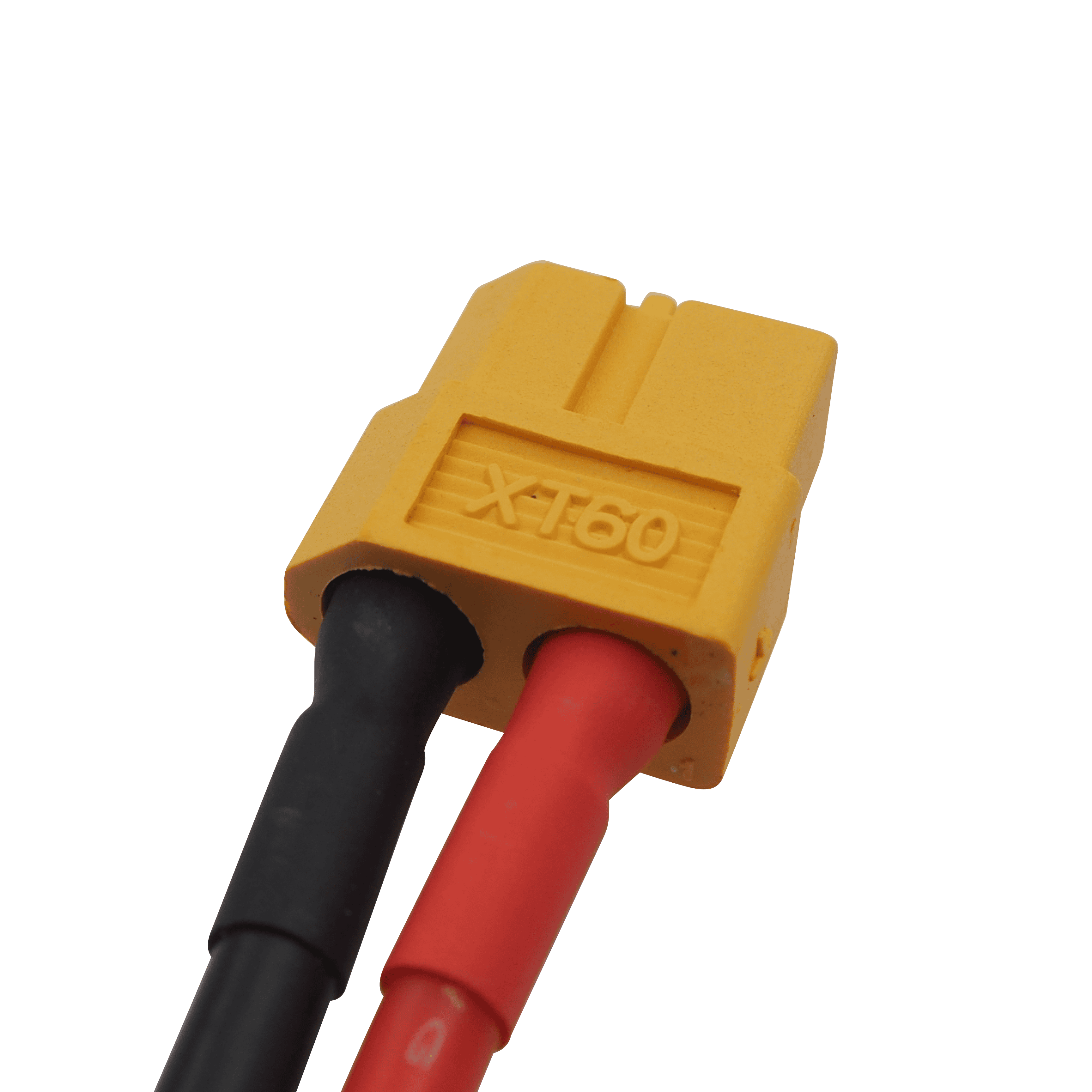
The XT range from Amass is the de-facto standard for medium-to-high-current packs in drones, EVs and power tools. The key members stocked by Keeppower are the Amass XT60-F connector, the Amass XT90S connector, plus XT30U, XT60H and AM-1015 formats:
Gold-plated contacts, gendered housings and a visible polarization key make these connectors difficult to reverse by accident, which is why OEM buyers standardize on them across product families.
- XT30U: the smallest XT format, used where space is tight. For example, the 4S2P 21700 14.4 V 12 Ah pack ships with an Amass XT30U connector and a built-in Japanese IC protection circuit.
- XT60 and XT60H: the general-purpose workhorse. The 6S1P 21700 FPV drone and UAV pack uses an XT60H-F connector.
- XT90 and XT90S: for higher current applications. XT90S adds an anti-spark design to reduce arcing when connecting live high-energy packs.
- AM-1015: an additional Amass option for specific builds; confirm polarity and contact rating with the product page.
Comparison: XT30U vs XT60 vs XT90 vs JST
| Connector | Typical continuous current (industry reference) | Connection type | Common applications |
|---|---|---|---|
| Amass XT30U | About 30 A | Power | Compact drones, small power packs |
| Amass XT60 / XT60H | About 60 A | Power | FPV drones, EV models, power tools |
| Amass XT90 | About 90 A | Power | E-Foils, high-power EV, large UAV packs |
| Amass XT90S | About 90 A, anti-spark | Power | High-energy packs connected live |
| JST XH | About 3 A per pin | Balance / signal | Multi-cell balance leads, PCM sensing |
| JST PH | About 2 A per pin | Signal | Low-current signal and auxiliary circuits |
Note: current ratings above are typical industry reference values for each connector family, not Keeppower test data. Confirm the exact rating against the supplier datasheet for your design, including continuous versus peak current and contact temperature rise.
JST XH and PH: Balance Leads and Signal Connections
Power connectors carry the main discharge current; JST connectors carry everything else. JST XH, with its 2.5 mm pitch, is the standard balance lead on multi-cell packs: the three-pin through six-pin headers that let the PCM monitor each cell node individually. JST PH, at 2.0 mm pitch, is used for low-current signal lines, thermistor feeds and auxiliary contacts. The rule of thumb is simple: never route balance or signal current through an XT connector, and never try to carry pack discharge current through a JST, because the contact area and pin locking are not sized for it.
PCM Protection Boards: The Safety Core of Every Pack
Worked Example: 4S-1548 Protection Board
Every multi-cell pack needs a protection board, and the PCM category covers 1S through 4S configurations. A representative unit is the 4S-1548 PCM for 4-series Li-ion packs, with the following parameters per Keeppower product pages:
When selecting a PCM, match the over-current threshold to the pack maximum expected discharge current with margin: a power-tool pack drawing 15 A continuously needs a higher threshold than a sensor node drawing under 1 A. Likewise, confirm that the over-charge threshold matches your cell chemistry, since Li-ion and LiFePO4 nodes use different voltage windows.
- Overcharge protection: 4.27 plus or minus 0.025 V per cell.
- Over-discharge protection: 2.3 plus or minus 0.05 V per cell.
- Over-current protection: 10 plus or minus 5 A, with a 20 plus or minus 3 ms delay.
- Short-circuit protection: triggers within 300 plus or minus 200 microseconds.
- Protection IC made in Japan; board size 48 x 15 x 1.0 mm; customizable.
Battery Cases, Spacers and Holders
Mechanical integrity is electrical safety in disguise: cells that shift inside a pack abrade their insulation and stress their welds. Keeppower battery cases cover the common cylindrical formats: M1, M3 and M6 for one, two and six 18650 cells, where the M6 case holds six 18650 cells, K1 and M4 for 21700 cells, an S2 silicone holder for two 18650 cells, D3 for 14500 and 16340, A4 for four 14500 or AA cells, and D1 accepting two 18650 cells plus four 26650 cells. For custom packs, battery spacers and holders, including the 18650 battery pack spacer and holder, keep cells aligned and leave the air gaps needed for cooling.
USB Adapters and Cables
USB power is how most teams bench-test, and how consumer-facing packs charge. Keeppower USB adapters category includes 5 V 2 A adapters in EU, US and UK standards; the EU-standard 5 V 2 A USB adapter is the default for European customers. These pair with USB cables such as Micro-USB leads in 0.8 m and 1.0 m lengths and shorter 20 to 25 cm leads for integrated builds. When sizing a USB chain, remember that the adapter must supply the charger input current: an undersized adapter is the most common cause of slow or aborted charge cycles on the bench. As a rule of thumb, choose an adapter rated for at least the charger input current, keep cable runs short to limit voltage drop, and confirm the plug standard for the destination market, since EU, US and UK wall heads are not interchangeable.
How to Select Accessories by Application
Once the connector and PCM are fixed, the remaining accessory choices mostly follow from one question: how much continuous current does the pack deliver, and how often is it connected and disconnected? High-cycle applications, such as drone packs swapped between flights, need contact systems that survive repeated mating without developing high resistance; fixed installations, such as smart-lock or medical packs, can prioritize small signal connectors and compact cases. The checklist below groups the most common applications by connector class, protection level and mechanical hardware.
Whatever the application, Keeppower customizes capacity, maximum discharge current, private label, wires, connectors and packaging as part of the OEM process, documented in the customized battery pack range.
- FPV drones and UAVs: XT60H power connector with a six-cell JST XH balance lead; choose the smallest XT format that still covers continuous current.
- E-Foils, e-bikes and high-power EV models: XT90 or the anti-spark XT90S, since these packs deliver tens of amps and connector heat or arcing is the failure mode to avoid.
- Power tools and handheld high-discharge devices: XT60 with reinforced strain relief, and PCM over-current thresholds set above tool inrush current.
- Medical, smart-lock, lighting and radio packs: JST signal connectors for comms and thermistor lines, plus a PCM matched to the cell count.
- Desk and bench setups: 5 V 2 A USB adapters with region-correct plugs and cable lengths matched to the charge input.
FAQ
What is the difference between XT60 and XT90 connectors?
Both are Amass power connectors, but XT90 is sized for higher continuous current, with a typical industry reference of about 90 A versus about 60 A for XT60, using larger contacts and housings. Choose XT90 for high-energy packs such as eFoils, and XT60 for FPV drones and mid-power tools.
When do I need an anti-spark XT90S?
Use XT90S when high-energy packs will be connected live: the anti-spark design reduces arcing at the moment of contact. If the pack is always disconnected before power is applied, a standard XT90 is sufficient.
Can I use JST XH as a power connector?
No. JST XH and PH are balance and signal connectors rated at only a few amps per pin. They are designed for cell-node monitoring and low-current signals; the main discharge current must go through an XT or similarly rated power connector.
What does a PCM protection board do in a battery pack?
A PCM disconnects the pack when cells are overcharged, over-discharged or shorted, and trips over-current above a set threshold. The 4S-1548, for example, trips at 4.27 V per cell on charge, 2.3 V per cell on discharge, 10 A over-current, and within microseconds of an external short circuit.
Which battery case fits six 18650 cells?
The M6 case holds six 18650 cells. Keeppower also stocks M1 and M3 for one and two 18650 cells, K1 and M4 for 21700 cells, and dedicated holders for 14500, 16340 and AA formats.
What USB adapter should I use with a smart charger?
Use a 5 V 2 A adapter rated for your region, with EU, US or UK plugs as applicable, and a cable that carries the required current without voltage drop. Undersized adapters are the most common cause of slow charging or failed bench tests.
Accessories are where battery packs succeed or fail in the field. Standardize connectors by power class, protect every cell node with a correctly rated PCM, hold cells mechanically with cases and spacers, and match USB adapters to the charge input. Keeppower OEM team can spec the full accessory set alongside your custom battery pack project, from XT30U to XT90S and from 1S to 4S PCMs.