

Table des matières
- The Building Blocks: How Series and Parallel Work
- Series connections raise voltage
- Parallel connections raise capacity
- Combining Series and Parallel: S/P Configurations
- Real pack examples from Keeppower
- Sizing cells: capacité, energy and why it matters
- Choosing the PCM Protection Board
- What a PCM actually protects
- Reading protection thresholds: the 4S-1548 example
- Assembly, Welding and Mechanical Points
- Spot welding versus soldering and cell matching
- Connecteurs, spacers and the physical pack
- From Prototype to Production: The Custom Pack Process
- Defining requirements
- The five-step custom workflow
- FAQ
- What does 4S2P mean in a battery pack?
- Should I add cells in series or parallel for more runtime?
- What is a PCM and why does a battery pack need one?
- How do I choose the right PCM voltage and current rating?
- How long does a custom Keeppower pack take?
The Building Blocks: How Series and Parallel Work

Series connections raise voltage
Cells have a nominal voltage set by chemistry — roughly 3.6 to 3.7V for a Li-ion cylindrical cell and about 3.2V for LiFePO4. A single cell cannot supply the 12V-class voltage that most portable devices, power tools and backup systems expect. Connecting cells in series, abbreviated S, stacks their voltages: two Li-ion cells in series deliver about 7.4V, four in series about 14.4 to 14.8V. Capacity in amp-hours stays at the single-cell value, while total energy in watt-hours increases because the voltage rises.
The trade-off is that series wiring exposes the weakest cell in the chain. Under charge, the cell with the lowest capacity reaches over-voltage first; under discharge, it hits over-discharge first. That is why series strings need both a protection board and, ideally, cells that have been voltage- and capacity-matched before assembly.
Parallel connections raise capacity
Connecting cells in parallel, abbreviated P, does the opposite: the total voltage stays at one cell's nominal value, while capacity in amp-hours adds up. Two 3500mAh cells in parallel deliver 7000mAh at the same 3.6 to 3.7V. Parallel strings also split the load current, so each cell contributes less and the pack can deliver higher total current with less voltage sag.
The risk in parallel is a low-resistance short circuit. Because parallel cells all sit at the same node, any internal short in one cell dumps current from the others into it. Cell matching and carefully welded interconnects are therefore essential. The table below summarizes the two directions side by side.
| Attribute | Série (S) | Parallèle (P.) |
|---|---|---|
| Tension | Increases (V total = N × V cell) | Unchanged (= V cell) |
| Capacité (Ah) | Unchanged (= Ah cell) | Increases (Ah total = N × Ah cell) |
| Énergie (What) | Increases | Increases |
| Current per cell | Same (full load through each cell) | Inférieur (load split across cells) |
| Résistance interne | Adds up | Reduced |
| Main risk | Weakest cell reaches over/under-voltage first | Short in one cell drains all parallel cells |
| Protection focus | Per-cell over-charge / trop décharger | Over-current and short-circuit response |
Combining Series and Parallel: S/P Configurations
Real pack examples from Keeppower
Practical packs combine both: the S number sets voltage and the P number sets capacity. Garder le pouvoir's catalog includes representative custom packs that make this concrete. Le 4S2P 21700 paquet is four cells in series and two in parallel, giving a nominal 14.4V (14.8V) and 12Ah with a 10Ah minimum, built with 21700 cellules, a Japanese IC protection circuit and an Amass XT30U connector, sized 178.0 × 75.0 × 22.5mm and rated for more than 500 cycles (per Keeppower product pages). Le 4S6P A123 LiFePO4 pack uses four series by six parallel on 26650 cells — 24 cells in total — for a 13.2V nominal, 15Ah pack with a 14.4Ah minimum, plus que 1000 cycles and an operating window of −30 to +55°C.
| Example pack | Configuration | Tension nominale | Capacité | Chimie |
|---|---|---|---|---|
| Keeppower 4S2P 21700 paquet | 4 série, 2 parallel (8 cellules) | 14.4V (14.8V) | 12 Ah (min 10 Ah) | Li-ion 21700 |
| Keeppower 4S6P A123 pack | 4 série, 6 parallel (24 cellules) | 13.2V | 15 Ah (min 14.4 Ah) | LiFePO4 26650 |
Sizing cells: capacité, energy and why it matters
To choose an S/P count, start from the load. Decide the system voltage, which sets S, then divide the required watt-hours by the per-cell energy to decide P. Remember that the capacity of a parallel string is bounded by the weakest cell, and that protection thresholds are applied per series cell rather than per parallel group. Keeppower custom packs can be specified for capacity, courant de décharge maximum, marque privée, fils, connectors and packaging, so the S/P count is only the starting point of the design. For a deeper walk-through, see the series versus parallel battery pack overview.
Choosing the PCM Protection Board
What a PCM actually protects
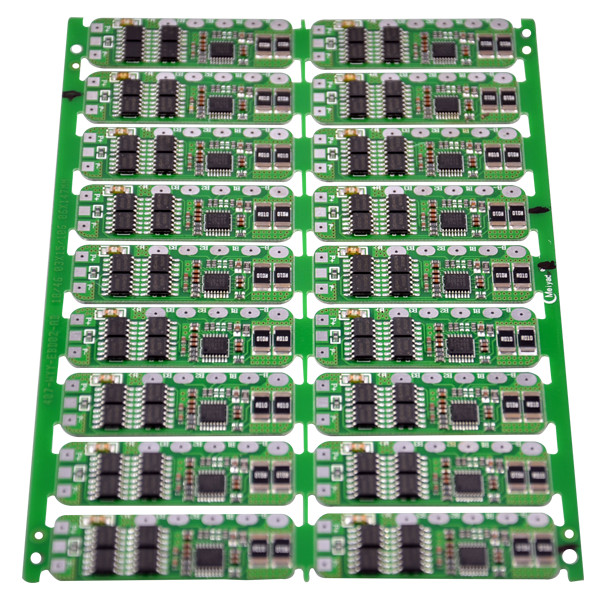
The PCM — protection circuit module, often called a protection PCB — is the small board that sits between the cell network and the output leads. It monitors each cell in the series string and cuts charge or discharge power when a threshold is crossed. A basic Li-ion PCM provides four functions: over-charge detection, over-discharge detection, over-current detection and short-circuit protection. Garder le pouvoir's protected cells and packs integrate a Japanese-made protection IC across its product line, et le PCM category spans 1S through 4S models with customizable thresholds.
Reading protection thresholds: the 4S-1548 example
Choosing a PCM means matching its thresholds to the cells and the application. Garder le pouvoir's 4S-1548 four-series PCM is a useful reference: it detects over-charge at 4.27 ± 0.025V per cell, over-discharge at 2.3 ± 0.05V per cell, over-current discharge at 10 ± 5A with a 20 ± 3ms delay, and short circuit with a 300 ± 200µs response; the board measures 48 × 15 × 1.0mm and is built around a Japanese IC (per Keeppower product pages). These published numbers are a practical template for comparing any protection board you are evaluating.
| Protection item | Setting on the 4S-1548 (per Keeppower product page) |
|---|---|
| Over-charge detection | 4.27 ± 0.025 V per cell |
| Over-discharge detection | 2.3 ± 0.05 V per cell |
| Surintensité (décharge) | 10 ± 5 UN |
| Over-current delay | 20 ± 3 MS |
| Short-circuit delay | 300 ± 200 µs |
| Board dimensions | 48 × 15 × 1.0 mm |
Assembly, Welding and Mechanical Points
Spot welding versus soldering and cell matching
Once the electrical design is set, mechanical assembly determines real-world reliability. Cells in a string should be voltage- and capacity-matched before assembly; mismatched cells drift apart cycle after cycle and shorten the pack life. Interconnects are normally spot-welded nickel tabs rather than hand-soldered, because soldering heat can damage cells and create inconsistent joints. Garder le pouvoir's protected cells with nickel tabs illustrate the approach, and custom packs use the same welded busbar style internally.
Connecteurs, spacers and the physical pack
The pack still needs a safe mechanical home: spacers or holders fix the cells, insulation prevents shorts, and the output connector must carry the discharge current. Keeppower supplies accessories alongside its packs — connecteurs such as the Amass XT60, battery spacers and holders, battery cases and USB adapters. For an overview of how connecteurs, PCMs, cases and spacers work together, the accessories guide is a practical reference before a custom quote is requested.
From Prototype to Production: The Custom Pack Process
Defining requirements
Before any pack is built, the requirements sheet should state the target voltage and capacity, the continuous and peak discharge current, the charge method, the dimensions and mounting, the connector type, the operating temperature range, the certifications needed, and any private-label or packaging requirements. The more complete this sheet, the faster the sample. Buyers new to custom sourcing can use the custom Li-ion pack design checklist as a starting template.
The five-step custom workflow
Garder le pouvoir's own FAQ on the contact page describes the standard custom flow: you state your requirements for voltage, capacité, charge and discharge current, taille, connector and appearance; Keeppower proposes a solution; you confirm price, quantity and payment terms; you approve the samples; and production follows. Keeppower supports Li-ion, Li-polymère, prismatic and LiFePO4 chemistries, custom packs are organized by the catégorie de batterie personnalisée, and the company reports that 95% of orders ship within one week — a useful metric when program timing matters.
FAQ
What does 4S2P mean in a battery pack?
4S means four cells in series, which sets the voltage to about 14.4 to 14.8V for Li-ion, and 2P means two cells in parallel within each series position, roughly doubling capacity. Garder le pouvoir's 4S2P 21700 pack is a real example: 14.4V and 12Ah, built with an integrated protection circuit.
Should I add cells in series or parallel for more runtime?
For more runtime and capacity, add cells in parallel. For higher voltage, add cells in series. Most real packs combine both: the S count sets the system voltage and the P count sets the runtime. A 4S2P build, Par exemple, raises voltage four times and capacity two times.
What is a PCM and why does a battery pack need one?
A protection circuit module monitors each series cell and disconnects the pack on over-charge, trop décharger, over-current or short circuit. Without it, a single weak cell can be damaged or overheated. The Keeppower 4S-1548 is the reference 4-series PCM with published thresholds of 4.27V over-charge and 2.3V over-detection.
How do I choose the right PCM voltage and current rating?
Match the series count (1S, 2S, 3S, 4S or beyond) to your cell string, set the over-charge and over-discharge thresholds to your cell chemistry, and choose an over-current rating above your pack's maximum continuous load with margin. Response speed matters for short-circuit protection; the 4S-1548 responds to a short in about 300 microseconds.
How long does a custom Keeppower pack take?
The standard flow is requirements, a proposed solution, confirmed price and payment, approved samples, then mass production. Keeppower reports that 95% of orders ship within one week and that its sales engineers average around nine years of experience, which shortens the iteration cycle for custom packs.


