

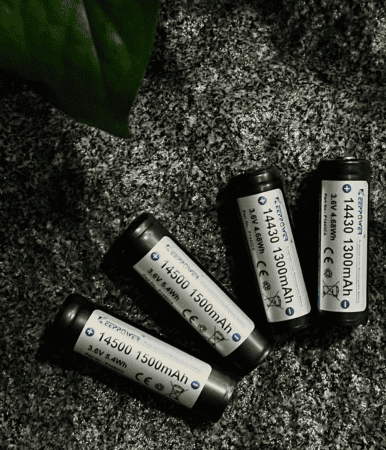
LiFePO4 and lithium-ion batteries are both widely used rechargeable power sources, but they are designed for different performance priorities. LiFePO4 batteries are known for their strong thermal stability, long cycle life and safety characteristics. Conventional lithium-ion batteries generally provide higher energy density, lower weight and more compact designs.
Choosing between LiFePO4 and Li-ion batteries is an important decision for product designers, equipment manufacturers and engineering teams. The battery chemistry affects voltage, 容量, 重量, charging requirements, service life, operating temperature and total system cost.
A battery that performs well in a portable electronic device may not be the best choice for a robot, medical instrument, backup system, industrial sensor or electric mobility product. The correct selection must be based on the complete application.
Keeppower provides rechargeable lithium batteries, 受保护的电池, 高容量电池, high-discharge cells and custom battery packs. Its product categories include LiFePO4 battery packs, 锂离子电池组, cylindrical cells, charging products and battery accessories.
This guide explains the differences between LiFePO4 and Li-ion batteries and shows how to choose the right chemistry for a particular product.
目录
- What Are LiFePO4 and Li-ion Batteries?
- Main Differences Between LiFePO4 and Li-ion Batteries
- Safety and Thermal Stability
- Energy Density and Product Weight
- Cycle Life and Long-Term Reliability
- Charging and Voltage Requirements
- Temperature Performance
- Applications for LiFePO4 Batteries
- Applications for Conventional Li-ion Batteries
- How to Select the Right Battery Chemistry
- 常见问题解答
What Are LiFePO4 and Li-ion Batteries?
Li-ion is a broad term used to describe rechargeable batteries that use lithium ions to transfer charge between the anode and cathode. Different lithium-ion batteries use different cathode materials, and these materials influence voltage, energy density, safety and service life.
LiFePO4 is short for lithium iron phosphate. It is one specific type of lithium-ion chemistry. In many product descriptions, Li-ion refers to chemistries such as lithium nickel manganese cobalt oxide or lithium nickel cobalt aluminum oxide, while LiFePO4 refers specifically to lithium iron phosphate cells.
Both chemistries can be manufactured in cylindrical, prismatic or pouch formats. They can also be assembled into battery packs with series and parallel connections, 保护电路, 连接器, temperature sensors and battery management systems.
Customers can explore the Keeppower product center to view different battery categories and available pack configurations.
Main Differences Between LiFePO4 and Li-ion Batteries
The most important difference is the balance between energy density, 安全, cycle life and voltage.
| 特征 | 磷酸铁锂电池 | Conventional Li-ion battery |
|---|---|---|
| Cathode chemistry | Lithium iron phosphate | Various lithium-based cathode materials |
| Nominal cell voltage | Usually around 3.2 V | Commonly around 3.6 V or 3.7 V |
| Energy density | 缓和 | Generally higher |
| 热稳定性 | Very strong | Depends on the specific chemistry |
| Cycle life | Often long | Varies by model and operating conditions |
| 重量 | Usually higher for the same energy | Usually lower for the same energy |
| High-current performance | Often strong | Depends on cell design |
| Best suited for | 安全, long life and stable operation | 袖珍的, lightweight and high-energy products |
These values are general guidelines. The actual performance depends on the cell design, 充电方式, 当前的, 温度, protection system and operating conditions.
Safety and Thermal Stability
Safety is one of the most important reasons manufacturers select LiFePO4 batteries. Lithium iron phosphate chemistry has strong structural stability and generally provides good resistance to thermal runaway compared with some higher-energy lithium-ion chemistries.
This makes LiFePO4 attractive for equipment that must operate for long periods, remain unattended or work in demanding environments. Examples include backup systems, 工业设备, solar storage products and some electric mobility applications.
然而, no lithium battery is completely risk-free. Safe operation still depends on:
- Correct charging voltage
- Proper current control
- Protection against overcharge and over-discharge
- Cell balancing
- Appropriate wiring
- Mechanical protection
- Thermal management
- Correct storage conditions
Keeppower 优惠 磷酸铁锂电池组 for projects that require a stable rechargeable power source. A customized pack can include protection components, connectors and dimensions suited to the final device.
Conventional Li-ion batteries can also be safe when correctly designed and properly protected. The safety design must match the selected chemistry and the application’s operating conditions.
Energy Density and Product Weight
Energy density describes how much energy a battery can store relative to its weight or volume. Conventional lithium-ion batteries generally have higher energy density than LiFePO4 batteries.
This gives conventional Li-ion batteries an advantage in applications where size and weight are critical. 便携式电子产品, compact flashlights, 无人机, cameras and handheld instruments may benefit from a lighter battery with higher energy storage.
LiFePO4 batteries may require more physical volume or weight to provide the same total energy. 然而, the additional weight may be acceptable when safety, cycle life and stability are more important than maximum compactness.
例如, a stationary backup device may have enough space for a larger battery pack. In that case, choosing LiFePO4 can provide long-term reliability without creating a major design problem.
The best chemistry depends on the product priorities:
- Choose conventional Li-ion when minimum size and weight are critical.
- Choose LiFePO4 when long service life and thermal stability are more important.
- Consider a custom pack when the product has unusual shape or space requirements.
Cycle Life and Long-Term Reliability
Cycle life describes the number of charge and discharge cycles a battery can complete before its capacity decreases to a specified level.
LiFePO4 batteries are commonly selected for applications that require frequent cycling. They can be suitable for systems that charge and discharge every day, including energy storage, backup power and industrial equipment.
A long cycle life can reduce replacement frequency and maintenance requirements. Although the initial cost of a LiFePO4 pack may be higher in some cases, its total cost of ownership may be attractive when the battery is used frequently for several years.
Conventional Li-ion batteries also provide useful cycle life, but the actual result varies significantly according to chemistry, discharge depth, charging rate, temperature and storage conditions.
To extend the life of either chemistry:
- Avoid unnecessary deep discharge.
- Use a compatible charger.
- Control charging temperature.
- Avoid excessive current.
- Store the battery in an appropriate environment.
- Use protection and balancing circuits where required.
Charging and Voltage Requirements
LiFePO4 and conventional Li-ion batteries require different charging parameters. They should not be treated as interchangeable simply because both are rechargeable lithium batteries.
A typical LiFePO4 cell has a nominal voltage near 3.2 V, while many conventional lithium-ion cells have a nominal voltage near 3.6 V or 3.7 V. Their full-charge voltages are also different.
Using the wrong charger can cause poor performance, reduced service life or a safety problem. Product designers must verify:
- Nominal voltage
- Maximum charging voltage
- Recommended charging current
- Cutoff voltage
- Cell balancing requirements
- Charger communication
- Battery management system settings
A battery pack with several cells connected in series requires a charger designed for the complete series voltage. The protection circuit must also be configured for the selected chemistry.
For portable products that need simple charging, Keeppower提供 USB受保护的电池 with USB Type-C or Micro USB interfaces. These products are suitable for applications that benefit from integrated charging.
Temperature Performance
Temperature affects battery capacity, 内阻, charging speed and service life.
LiFePO4 batteries are often selected for applications that require stable operation across demanding conditions. 然而, low-temperature charging still requires careful control. Lithium batteries should not be charged outside the approved temperature range.
Conventional Li-ion batteries can also operate across a wide temperature range, but their performance depends on the specific cell design. Some products may require low-temperature battery technology, thermal sensors or additional insulation.
When the equipment is used outdoors, engineers should evaluate:
- Minimum and maximum ambient temperature
- 充电温度
- Discharge temperature
- Heat generated during high-current operation
- Enclosure ventilation
- Waterproofing and condensation
- Cold-start performance
For specialized requirements, review the available low-temperature battery options and discuss the operating conditions with the manufacturer.
Applications for LiFePO4 Batteries
LiFePO4 is often considered for applications where safety, cycle life and stable operation are major priorities.
典型应用包括:
- 备份电源系统
- 太阳能储能
- Industrial control equipment
- Electric mobility products
- 机器人技术
- Security systems
- Communication equipment
- Medical and laboratory equipment
- 便携式发电站
- Long-term monitoring systems
A LiFePO4 pack may be particularly useful when the equipment is charged and discharged frequently or when battery replacement is difficult.
Keeppower also provides customized battery packs for applications that require specific voltage, 容量, 方面, connectors or protection functions.
Applications for Conventional Li-ion Batteries
Conventional Li-ion batteries are widely used when high energy density, compact size and low weight are important.
典型应用包括:
- 手电筒
- Portable instruments
- 相机
- Handheld electronics
- 无人机和无人机
- Wireless devices
- 电动工具
- 医疗器械
- Smart locks
- Radios
- High-performance lighting
Keeppower 优惠 classic protected lithium batteries in several popular cylindrical formats, 包括 18650, 21700 and other sizes.
For applications that require high current rather than maximum capacity, manufacturers can also review the high-discharge battery range.
How to Select the Right Battery Chemistry
Use the following questions when selecting between LiFePO4 and conventional Li-ion batteries.
1. Is the product space-constrained?
If the battery must be as small and light as possible, conventional Li-ion may provide an advantage because of its higher energy density.
2. Does the product require frequent cycling?
If the equipment is charged and discharged every day, LiFePO4 may be attractive because of its long cycle life.
3. Is safety the highest priority?
For equipment that operates unattended or in demanding environments, LiFePO4 may provide a useful safety advantage when correctly designed.
4. Does the device require high current?
Both chemistries can provide high current, depending on the cell model. Always check the continuous and peak discharge ratings.
5. Can the charger be changed?
If the product already has a fixed charger, confirm whether it supports the selected chemistry. Changing from Li-ion to LiFePO4 may require a new charging system.
6. What is the total ownership cost?
Consider the purchase price, expected service life, maintenance, replacement frequency and installation cost.
7. Does the product need a custom battery pack?
If the voltage, shape, connector or capacity is unusual, a custom pack is usually more suitable than combining random standard cells.
8. 需要什么认证?
Commercial and industrial products may require transportation, safety or market-access certifications. Discuss these requirements before finalizing the battery design.
常见问题解答
Is LiFePO4 a type of lithium-ion battery?
是的. LiFePO4 is one specific lithium-ion chemistry that uses lithium iron phosphate as the cathode material.
Which battery has higher energy density?
Conventional lithium-ion batteries generally provide higher energy density than LiFePO4 batteries. The actual value depends on the cell design and manufacturer.
Which battery lasts longer?
LiFePO4 batteries often provide longer cycle life, especially in applications with frequent charging and discharging. Actual life depends on temperature, current and charging conditions.
Can I use a Li-ion charger for a LiFePO4 battery?
未必. The charging voltage and control method may be different. Always use a charger designed for the selected chemistry.
Are LiFePO4 batteries safer?
LiFePO4 chemistry generally offers strong thermal stability. 然而, safe operation still requires correct charging, 保护, wiring, enclosure design and temperature control.
Which battery is better for drones?
The answer depends on the drone’s weight, flight time, peak current and pack dimensions. Conventional Li-ion may provide higher energy density, while a customized pack can be designed around the drone’s current and space requirements.
Can Keeppower design a custom LiFePO4 battery pack?
Keeppower lists customized battery packs and LiFePO4 battery pack products. Customers can contact the company with their voltage, 容量, 方面, connector and protection requirements.
What information should I provide when requesting a battery quotation?
Provide the required voltage, 容量, 连续电流, 峰值电流, 方面, 连接器类型, 充电方式, 温度范围, protection functions and estimated order quantity. You can submit project details through the Keeppower contact page.
结论
LiFePO4 and conventional Li-ion batteries both provide valuable advantages, but they serve different design priorities. LiFePO4 is often selected for safety, long cycle life and stable operation. Conventional Li-ion is often selected for high energy density, compact dimensions and lower weight.
The correct choice depends on the equipment’s operating conditions, charging system, available space, required runtime, current demand, service life and total cost of ownership.
Keeppower provides a broad selection of protected batteries, 高容量电池, high-discharge batteries, LiFePO4 packs, customized lithium battery packs, chargers and accessories. By defining the technical requirements before selecting a cell, manufacturers can build a safer, more reliable and more efficient power system.