目录
- 介绍
- How USB Rechargeable Lithium Batteries Work
- Type-C vs Micro-USB
- 常见应用
- aa 1.5 V Lithium as a Disposable Battery Replacement
- 购买指南: What to Check Before You Buy
- Charging speed and port power
- 保持力量's USB-C Lineup
- 常问问题
- What is a USB-C rechargeable lithium battery?
- How long does it take to charge a USB rechargeable battery?
- Is a USB rechargeable battery as powerful as a normal protected cell?
- Should I choose Type-C or Micro-USB?
- Can a rechargeable 1.5 V lithium AA replace alkaline?
- Are USB rechargeable batteries safe?
Contents
介绍

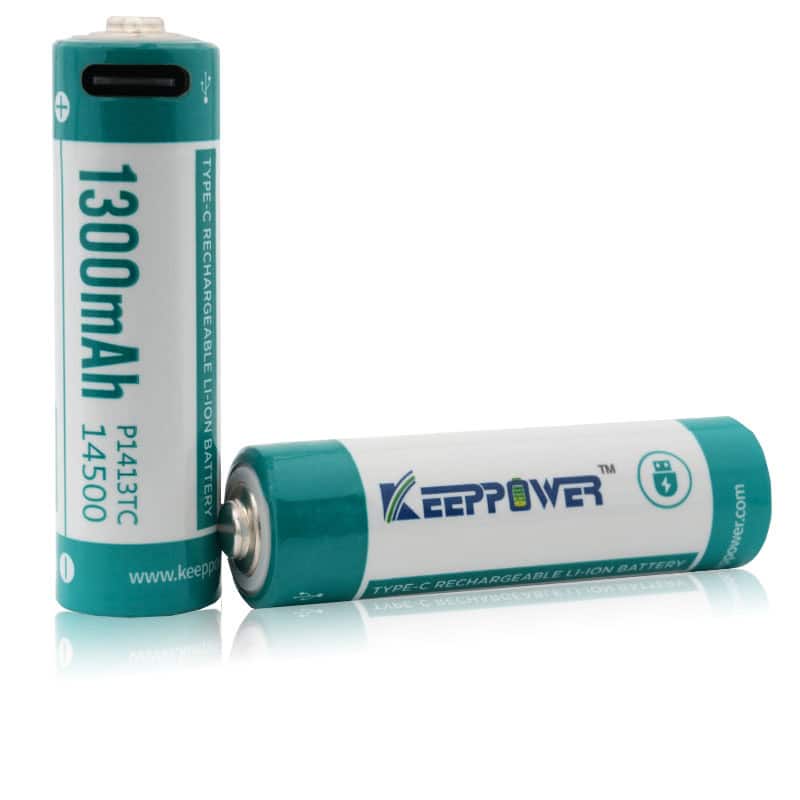
A USB-C rechargeable lithium battery looks like an ordinary cell but includes a tiny charging circuit and a USB port, so you recharge it from any phone charger, power bank or laptop port. No dedicated battery charger required. For OEMs and product designers, this removes a whole accessory from the bill of materials and removes a support burden for end users. This guide explains how these cells work, how Type-C compares with Micro-USB, representative products, and what to check before buying.
Keeppower manufactures USB-charged protected batteries in Dongguan, 中国, and publishes detailed buying guidance. Start with the USB rechargeable lithium batteries buying guide 和 USB-C benefits and limits article for the broader context; this page focuses on the product selection itself.
This guide is written for OEM engineers, product managers and sourcing specialists who are evaluating USB-charged cells as a product feature rather than a consumer novelty. It avoids generic marketing claims and anchors every specification to Keeppower's published product data, so the numbers can be quoted directly in datasheets and tender documents.
How USB Rechargeable Lithium Batteries Work
Inside the cell wrapper, a small protection and charge-management IC converts the 5 V USB supply into the CC-CV charging profile the lithium cell needs. The built-in PCM also guards over-charge, 过度关闭, over-current and short circuit. Representative specs, per Keeppower product pages: 这 P1835TC Type-C 18650 charges at 5.0 V from USB with a 1.5 A standard charging current (700 m A on a conventional lithium charger) and supports up to 8.0 A maximum continuous discharge. It stores 3500 毫安时, weighs about 50 g and is rated for more than 500 周期.
That combination, charge over USB and discharge at high current, is what makes USB cells viable in high-drain gear rather than only low-drain electronics. You can top up the flashlight cell from a power bank between outings, and still get the full current when the light ramps to turbo.
Conventional lithium cells must be charged on a dedicated smart charger that knows when to switch from constant current to constant voltage and when to terminate. That charger is an extra SKU, a warranty item, and something users routinely lose. A USB-charged cell moves that intelligence inside the wrapper: the user plugs in any standard 5 V USB source, and the cell manages its own charge cycle. For product teams, this simplifies accessories, reduces support tickets about lost chargers, and makes the product viable in markets where buyers expect everything to charge over USB.
Type-C vs Micro-USB
Type-C is reversible, durable and the connector found on modern phones and laptops. Micro-USB is still widely deployed in older accessories and some OEM product docks. Keeppower stocks both: 一个 Type-C USB battery category 和一个 Micro-USB category. Type-C wins on future-proofing and cable availability; Micro-USB wins on compatibility with existing product docks. Either way, the cells charge at 5 V and the same built-in PCM handles safety. The dedicated USB-C 18650 电池指南 walks through the most popular form factor in detail.
There is also a reliability argument. USB-C connectors are rated for tens of thousands of insertion cycles, while Micro-USB connectors are more fragile and directional. In industrial and rental equipment that is plugged and unplugged daily, USB-C reduces connector failures over the product's life, which is a quiet but real warranty cost saver.
常见应用
手电筒: a USB-charged 18650 means no hunting for a dedicated charger; top up from a power bank between outings. Remote controls and smart-home devices: recharge instead of buying disposable AA and AAA packs. 便携式电子产品: speakers, 相机, GPS units and field gear that already live on USB power. Workshop and hobby tools where spare chargers are easily lost or damaged.
Environmentally, the shift matters too. Each rechargeable cell replaces hundreds of disposable primary cells over its life, which cuts waste and removes the logistics of stocking alkaline packs. For OEM customers selling into regions with extended producer responsibility rules, that difference is worth quantifying in the product presentation.
aa 1.5 V Lithium as a Disposable Battery Replacement
A particularly useful format is the rechargeable AA 1.5 V lithium cell. Fresh alkaline AA delivers 1.5 V and sags under load; a rechargeable lithium cell with a DC-DC converter holds a flat 1.5 V through the whole discharge. 保持力量's P1450I3 is rated 4700 MWH (3133 毫安时), per its product page, giving hundreds of recharge cycles against a single-use alkaline, with stable voltage for cameras, toys, remote controls and medical devices.
The flat voltage behavior is what makes these cells attractive in devices that refuse to run on fading alkaline: motorized cameras, children's toys, and high-current remote controls keep performing at full speed until the cell is empty, instead of slowing down halfway through the alkaline's nominal life. The trade-off is that rechargeable lithium cells cost more upfront, but amortize over hundreds of cycles.
购买指南: What to Check Before You Buy
Compatibility: confirm the cell form factor (18650, 14500, aa) fits your device, and that the slightly longer protected wrapper is tolerated in the compartment.
Charging spec: note the USB input voltage (5 V) and the standard charging current. A faster charge is convenient, but check that your cable and charger can actually deliver the rated current.
放电电流: match the device's draw to the cell's maximum continuous discharge. The P1835TC supports up to 8.0 一个, per its product page, which is enough for high-drain flashlights and small tools.
认证: look for UN38.3, CE, 环保有害物质指令, MSDS and Regulation (欧盟) 2023/1542 文档. Keeppower lists these on its product pages, which matters for OEM resale and cross-border shipping.
Ecosystem: keep charging simple with a 5 V USB adapter and spare USB 电缆 from the same supplier, so spares stay compatible with every cell in the lineup.
Charging speed and port power
USB charging speeds depend on both the cell and the source. A standard USB 2.0 port delivers 5 V at up to 0.5 一个, a phone charger at 1 到 2 一个, and a fast-charge power bank more. Because the P1835TC draws a 1.5 A standard charging current, 一个 5 V 2 A adapter gives the fastest practical charge without stressing the cell. Keeppower stocks a 5 V 2 A USB adapter alongside the cells, so the charging kit can ship as one matched bundle rather than as three separate SKUs.
保持力量's USB-C Lineup
Start at the USB protected battery category, then narrow to C型 或者 Micro-USB. 科普科技有限公司, LIMITED has supplied industrial lithium batteries since 2008 from its Dongguan factory, and supports private label and custom packs. For the company's certification and service background, see the about page.
The custom program also extends the USB format. OEM buyers can specify private-label wrappers, matched capacities and bundled accessories for a complete charging ecosystem, rather than mixing cells from several suppliers. 保持力量's five-step custom process runs from requirement intake, to proposal, price and quantity confirmation, sample approval, and mass production, which keeps lead times predictable for production programs.
常问问题
What is a USB-C rechargeable lithium battery?
It is a lithium cell with a built-in charging circuit and a USB-C port, recharged at 5 V from any USB port without a dedicated charger. 保持力量's P1835TC Type-C 18650 charges at a 1.5 A standard current and delivers up to 8.0 A continuous, per product pages.
How long does it take to charge a USB rechargeable battery?
It depends on the cell and the port. The Keeppower P1835TC charges at a standard 1.5 A via USB (或者 700 mA on a conventional lithium charger), per its product page. A standard phone charger or power bank can supply it.
Is a USB rechargeable battery as powerful as a normal protected cell?
是的. The P1835TC delivers up to 8.0 A maximum continuous discharge, enough for high-drain flashlights, while its built-in PCM provides over-charge, 过度关闭, over-current and short-circuit protection.
Should I choose Type-C or Micro-USB?
Type-C is reversible, durable and matches modern phone and laptop cables. Micro-USB suits existing product docks and accessories. Keeppower offers both categories so you can match your product's existing connector ecosystem.
Can a rechargeable 1.5 V lithium AA replace alkaline?
是的. The Keeppower P1450I3 AA 1.5 V cell (4700 MWH / 3133 mAh per product page) holds a flat 1.5 V output and recharges for hundreds of cycles, replacing disposable AA in cameras, toys, remote controls and medical devices.
Are USB rechargeable batteries safe?
When built with a PCM and certified, 是的. 保持力量's USB cells carry UN38.3, CE, 环保有害物质指令, MSDS and Regulation (欧盟) 2023/1542 documentation per product pages, and the built-in IC protects against over-charge, 过度关闭, over-current and short circuit.