Table of Contents
- What an eFoil Battery Pack Has to Deliver
- Sizing the Pack: Voltage, Capacity and Runtime
- Matching Discharge to Throttle Demand
- Waterproofing and Enclosure Design
- Connectors, Wiring and Balance Leads
- Safety, Certification and Shipping
- How Keeppower Builds Custom eFoil Packs
- FAQ
- How long does an eFoil battery last on a charge?
- Can I charge an eFoil battery in the water?
- What is the difference between a Li-ion and LiPo eFoil pack?
What an eFoil Battery Pack Has to Deliver
An electric hydrofoil (eFoil) surfboard is one of the more demanding consumer power applications on the water. Its battery must supply high peak current during takeoff and acceleration, hold a stable voltage through a ride, survive repeated splashes, spray and occasional full immersion, and remain light enough not to compromise board buoyancy and handling. That combination of high discharge, moisture resistance and weight sensitivity makes the eFoil battery a specialized product rather than an off-the-shelf pack.
This guide walks through how to size and specify a hydrofoil surfboard battery, covering cell selection, pack architecture, waterproofing, connectors, safety certification and the OEM build process. It follows our earlier look at waterproof lithium packs for eFoils and pairs naturally with the broader custom OEM battery pack guide.
Keeppower manufactures custom lithium packs for marine and outdoor equipment, including eFoil batteries, ROV and sonar packs, drone and UAV packs, and portable device batteries. Each pack is built around qualified cells, a protection circuit sized to the load and a mechanical assembly that addresses the specific environmental risks of its application.

Sizing the Pack: Voltage, Capacity and Runtime
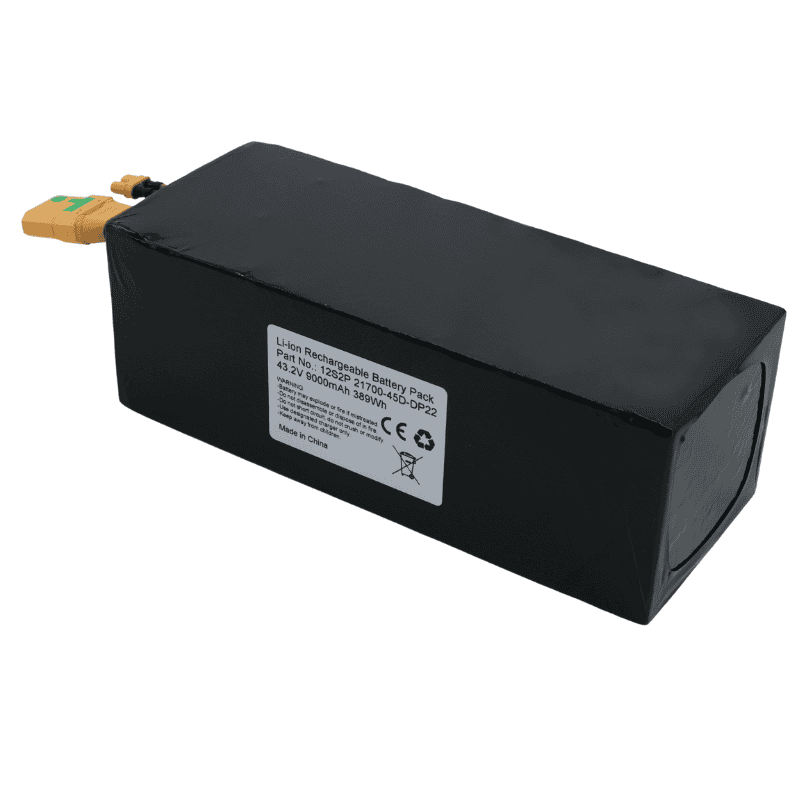
Sizing an eFoil pack begins with the propulsion system. The motor controller requires a defined nominal voltage and a maximum current draw, and those two figures determine the series cell count and the minimum continuous discharge rating of the pack. Runtime and the rider’s weight, board size and typical riding style then set the capacity, which in turn determines the parallel count and the pack’s physical size.
Volts multiplied by amp-hours give the watt-hours stored in the pack, and watt-hours are the clearest measure of expected runtime against the motor’s power draw. A pack that looks adequate on voltage alone can still disappoint if its capacity is too low for the planned session, so the sizing calculation should start from a realistic mission profile rather than from a single maximum current figure.
Matching Discharge to Throttle Demand
eFoil motors draw their highest current during takeoff, when the board must rise onto the foil, and during sharp acceleration. The pack’s continuous and peak discharge rating must cover these surges without excessive voltage sag or heating. Cells with a suitable high-discharge rating are selected for the current profile, and the protection board is set to cut off before over-current or over-discharge damages the cells. Keeppower’s high-discharge cells and high-capacity cells are matched to these two competing demands, just as they are in the 21700 battery packs used in high-current equipment.
| Parameter | Role in Pack Sizing | Check Against |
|---|---|---|
| Nominal voltage (S count) | Determines pack voltage and compatibility with the controller | Motor/controller input voltage range |
| Capacity (Ah / Wh) | Sets expected runtime on the water | Rider weight, board load and session length |
| Continuous / peak current | Defines headroom for throttle surges | Motor maximum draw and startup current |
| Cell rating | Determines heat buildup and voltage stability | Discharge profile and duty cycle |
| Sealing and enclosure | Protects against spray, immersion and impact | Water exposure and transport conditions |
Waterproofing and Enclosure Design
Water resistance is what separates an eFoil pack from a general-purpose power pack. The enclosure must seal around every cable exit and connector, resist pressure changes and impact, and keep salt spray and fresh water away from cell terminals and the protection board. Cable glands, sealed contact exits and reinforced strain relief are designed as part of the housing, and the finished pack is inspected and tested before release.
Thermal management is related but distinct. A pack under heavy load generates heat, and a sealed enclosure cannot rely on forced air cooling. Cell spacing, internal layout and the protection board’s temperature cutoffs are chosen so that heat is managed without making the pack oversized. For operation in cold water, the voltage drop and capacity loss of standard cells should be considered; low-temperature cells may be specified where cold conditions are expected.
Connectors, Wiring and Balance Leads
The power connector carries the full motor current, so it must be rated above the pack’s maximum continuous draw and chosen for a secure, polarized connection. Amass XT-series connectors are common in high-current packs, while JST-style connectors handle balance and signal connections. The connectors range stocked by Keeppower includes these power and signal formats, and the XT60, XT90 and JST connector guide compares them by current rating and use case.
Wiring gauge is sized to keep voltage drop and heating acceptable across the harness, and balance leads are routed so they cannot be pinched or chafed against the enclosure. Nickel tabs and cell connections are ultrasonically or resistance welded according to the pack design, and spacers or holders keep cells fixed during vibration. The surrounding accessories, including battery cases and spacers and holders, are selected to match the cell count and enclosure geometry.

Safety, Certification and Shipping
Any lithium pack shipped across borders must meet transport safety requirements. UN38.3 testing covers cell and pack safety against short circuit, overcharge, forced discharge, thermal, vibration, shock and other abuse conditions, and the accompanying documentation is required for air and sea freight. Our UN38.3 safety and transport guide explains what the certification process involves for battery buyers.
Beyond transport, buyers should confirm the quality system and component marks that apply to their product. Keeppower operates under an ISO9001:2015 quality framework, and cells and accessories are sourced where UL, CB, IEC, UN, CCC, ETL, CE and RoHS documentation is available. Requesting the actual certificates and test reports for a proposed pack reduces the risk of compliance gaps later in the supply chain.
How Keeppower Builds Custom eFoil Packs
A custom eFoil pack project typically moves from a specification sheet to a working prototype in stages. First, the voltage, capacity, peak current, connector and enclosure requirements are defined from the motor and board design. Cells are then matched for capacity and internal resistance, arranged in the required series and parallel configuration, and paired with a protection board that guards against overcharge, over-discharge, over-current and short circuit. The assembly is sealed into the enclosure, fitted with the chosen power and balance connectors, and checked for capacity, load behavior and insulation before it ships.
The same core build process supports Keeppower’s underwater ROV and sonar packs, drone and UAV packs and other custom lithium packs, with the sealing and mechanical details tuned to each application. If you are developing an eFoil or another electric marine product, share your voltage, capacity and connector requirements through the contact page to request a custom pack quotation.
FAQ
How long does an eFoil battery last on a charge?
Runtime depends on pack capacity (Wh), motor power, rider weight, wind and sea conditions, and riding style. A higher-capacity pack gives a longer session but adds weight and volume. The correct sizing balances runtime against board buoyancy and handling, and it should be calculated from your typical power draw rather than a generic estimate.
Can I charge an eFoil battery in the water?
No. Charging should always be done on dry land with a matched charger, away from water, and the pack should be allowed to cool after a ride before charging. Never connect or disconnect the power connector while the motor is active, and inspect the enclosure and contacts for corrosion or damage before each use.
What is the difference between a Li-ion and LiPo eFoil pack?
LiPo (lithium polymer) packs are common in radio-controlled and some marine products for their high discharge and flexible form factor, while hard-case Li-ion cells offer strong energy density and a protected build. The right chemistry depends on the motor current, weight target and safety requirements; our chemistry comparison guide walks through the trade-offs in more detail.